
- English

Initially, people used ordinary activated carbon to adsorb hydrogen, and the hydrogen storage capacity could not reach 1% (mass fraction) even at low temperature, and even lower at room temperature. Therefore, the application of activated carbon as a hydrogen storage material was limited.
Until the late 1960s, people used activated carbon with larger specific surface area, smaller pore size and more uniformity, also known as super activated carbon (specific surface area of about 2000m2/g or more), as the main carrier for fuel gas storage, and found that its hydrogen storage capacity increased significantly. For example, some people used activated carbon with a specific surface area of up to 3000m2/g to store hydrogen, and the adsorption hydrogen storage capacity reached 5% (mass fraction) at -196℃ and 3MPa. Since then, this activated carbon hydrogen storage technology has attracted much attention from researchers.
ACC Super Activated Carbon specific Surface Area: 2500m²/g
Super activated carbon hydrogen storage is an adsorption hydrogen storage technology that uses ultra-high specific surface area activated carbon as an adsorbent at medium and low temperature (77~273K) and medium and high pressure (1~10MPa). The adsorption equilibrium of hydrogen on activated carbon at 77~298K is shown in the figure.
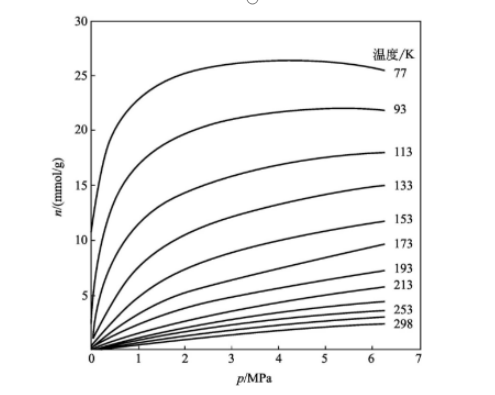
Adsorption equilibrium of 77-298K hydrogen on activated carbon
Previously, it was generally believed that the hydrogen storage of super activated carbon (high specific surface area activated carbon) belongs to physical adsorption, which is achieved by using the van der Waals force between its huge surface area and hydrogen molecules, and is a typical supercritical gas adsorption. First of all, the surface of activated carbon is the place where the adsorption phase depends, and the size of the specific surface area of activated carbon is one of the most important properties of physical adsorption.
At a constant temperature, the amount of H2 adsorbed is proportional to the surface area of the carbon material. The greater the surface area per unit mass of activated carbon, the greater the amount of hydrogen adsorbed, especially at high pressures. The second is pore distribution.
Larger pores are not helpful in increasing the amount of hydrogen adsorbed, but activated carbon with only micropores is not practical either, because the rate at which gas enters and exits the micropores will reach a level that cannot be used. So-called microporous activated carbon is generally based on micropores and still contains a certain proportion of mesopores and macropores.
Schwarz J A et al. have also studied the effect of functional groups and pH on the surface of activated carbon on the amount of hydrogen stored. Although there is an effect, it is not decisive.
In addition, the hydrogen storage capacity of activated carbon is closely related to temperature and pressure. At constant pressure, the amount of H2 adsorbed decreases exponentially with increasing temperature. At a given temperature, the amount of adsorption increases with increasing pressure and tends to stabilise when the pressure increases to a certain value. This means that the lower the temperature and the higher the pressure, the greater the hydrogen storage capacity, but the effect of pressure is smaller than that of low temperature.
The pressure of adsorption hydrogen storage is not high, and the adsorption amount increases rapidly with the decrease of temperature, indicating that adsorption hydrogen storage is suitable for low temperature. The mass fraction of hydrogen storage capacity is calculated to reach 7.4%. The adsorption of hydrogen on activated carbon is a physical equilibrium. At a constant temperature, the pressure for adsorption (hydrogen absorption) increases and the pressure for desorption (hydrogen release) decreases. From the measured adsorption isotherm, the desorption line coincides with the adsorption line and there is no retention effect.
This means that within a given pressure range, the amount of hydrogen absorbed during a pressure increase is equal to the amount of hydrogen released during a pressure decrease. Hydrogen absorption and desorption depend only on the change in pressure, so the absorption/desorption conditions are very mild.
Compared with other hydrogen storage technologies, super activated carbon adsorption hydrogen storage has the advantages of light weight of the storage;
① The hydrogen storage capacity can meet the mileage requirements;
② High specific surface area activated carbon can be mass-produced, low cost and can be used indefinitely;
③ Good gas storage safety;
④ Compared with the "on-vehicle hydrogen production" method, the equipment is simple, the investment is small, and it does not consume energy;
⑤ Liquid nitrogen directly bears the loss of thermal insulation, avoiding hydrogen leakage, which is not only low cost but also safer;
⑥ Liquid nitrogen is cheap.
It is a very potential and competitive hydrogen storage material, especially in low temperature adsorption hydrogen storage method, such as storage as automobile fuel.
For a given activated carbon, the lower the temperature, the higher the hydrogen storage capacity. On the one hand, the adsorption capacity at low temperature is high, and on the other hand, the density of hydrogen at low temperature is large, and the amount stored in the pores of activated carbon in a free state is also large.
The use of super activated carbon as a hydrogen storage medium will promote the development of low-cost, large-scale hydrogen storage technology, which will be of great significance to energy, transportation and environmental protection in the new century.
We firmly focus on customers, constantly strive to improve our work; To meet customer needs with high quality products and services.
+86 592 2278129
+86 592 2278123
Unit G 10/F, Zhenhaoge Building, Guomao Golden Coast, No.99 Lujiang Road, Xiamen, China, 361001
info@allcarbon.com.cn
* = Required Information